“In the short run, the stock market is a voting machine. But in the long run, it is a weighing machine.”
~ Benjamin Graham
The rise in long-term bond yields has been global. Investors around the world are demanding more compensation to commit capital amid resilient growth, inflation uncertainty, heavy government borrowing, and extraordinary investment in AI infrastructure.
Higher yields have created near-term price pressure for existing bonds1. At the same time, they also improve the prospective income and return potential of new bond purchases and reinvested cash flows.
Focus has shifted to the outcome of upcoming mid-term elections. What matters for investors is not simply which party wins, but whether Washington ends up divided, which tends to limit the possibility of sweeping policy change.
1 Bond prices move inversely with interest rates
Introduction
October has arrived and the extraordinary display of colors nature puts on each fall is upon us. This year, neighborhoods are filling with not just pumpkins and ghosts, but a fresh crop of yard signs. It is election season, and candidates are urgently trying to convey their message to voters before the midterms in November.
At the same time, fixed income investors have been holding their own kind of referendum. Bond buyers, taking the lead of global Central Banks, have held a protest vote and forced bond yields sharply higher since late August. The similarity between investors and voters is at the heart of Ben Graham’s quote above - one of the most famous there is about the stock market (and one we have used previously in this note but felt appropriate to recycle here). Voters and investors are both making choices based on how they see the future. Voters weigh competing promises about growth, taxes, spending, and national priorities. Investors weigh many of the same factors, then register their views through asset prices and the cost of capital.
Trick or treat may be one of the most commonly uttered phrases on October 31st, but for both the political and investment world, this season may prove to have some of both, or perhaps neither.
Bond Markets Cast Their Vote
The U.S. Treasury market is most often quoted when discussing the cost of borrowing, but the recent rise in interest rates has been broad-based. Government bond yields have risen across the curve and across major developed markets. The adjustment is reflecting a global repricing of capital rather than an isolated loss of confidence in U.S. bonds. Higher yields are not solely the result of the U.S. surpassing $40 trillion in debt as discussed in the previous Market Perspectives. Large public debt and deficits are part of the mosaic, but so are economic resilience and competition for capital.
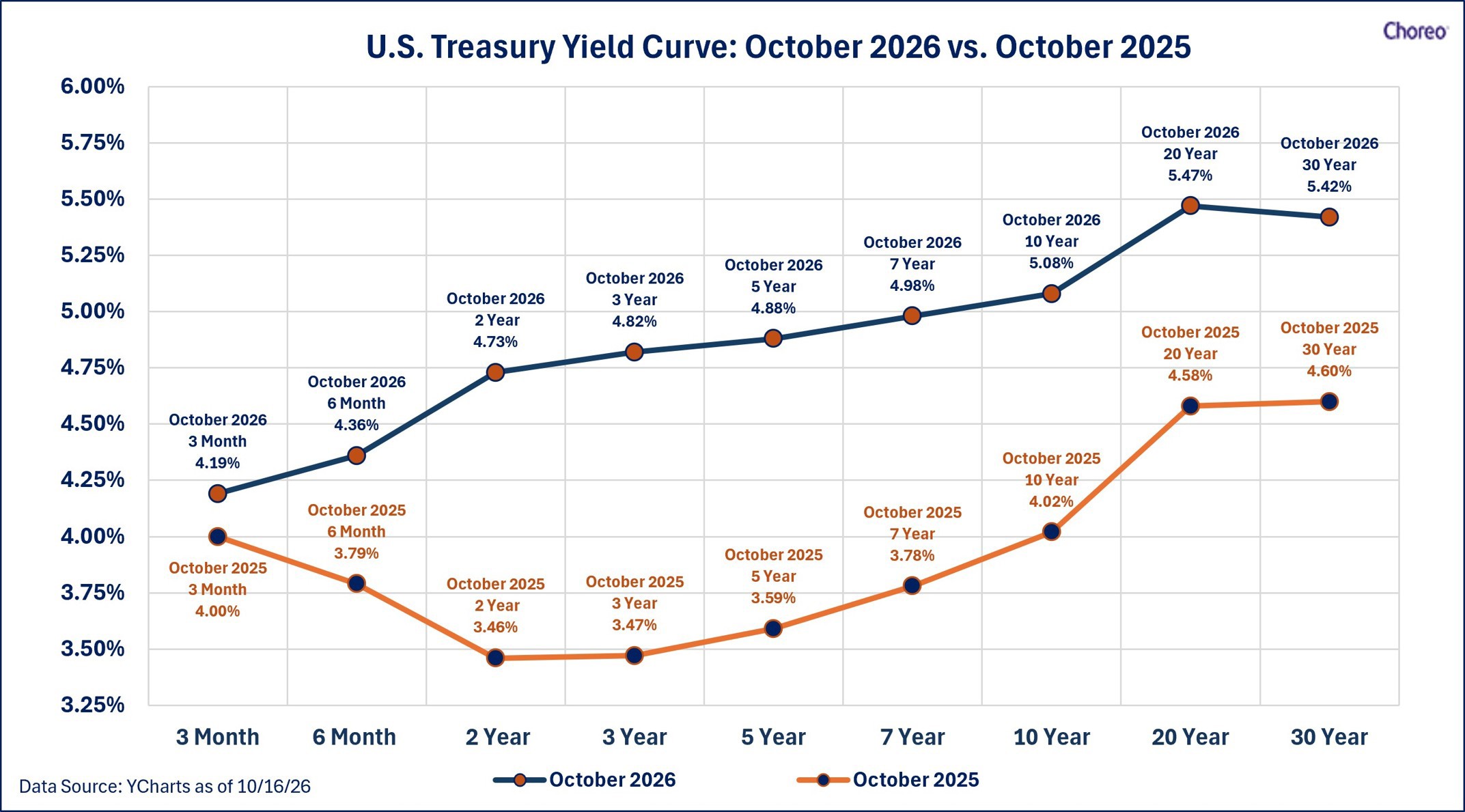
Stronger growth can keep demand for capital firm and prevent Central Banks from needing to lower policy rates, thus sustaining higher interest rates and potentially pushing them higher. In the U.S., monthly surveys across both manufacturing and service industries indicate an acceleration of economic activity recently. Measures of employment have been steady near historically high levels, and retail sales have been surprisingly resilient. This has flowed through to Gross Domestic Product (“GDP”), one of the broadest measures of economic strength, where second quarter growth was revised up from 1.5% to 2.2%, and third quarter GDP is now tracking above 3%.
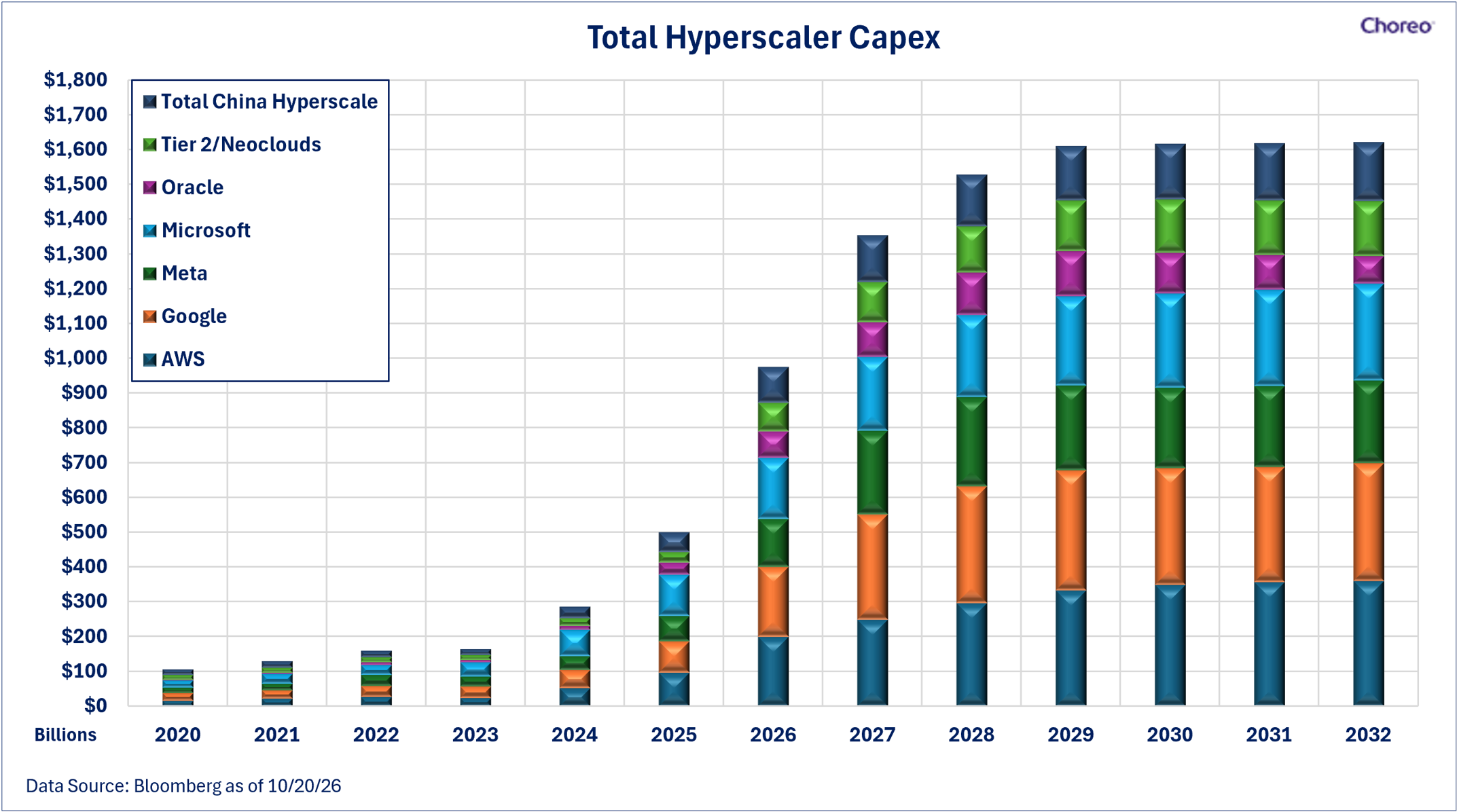
Another key factor in the movement of interest rates is demand from the AI buildout. Data centers, power generation, and related infrastructure require enormous upfront investment. As companies increase debt issuance for this development, the higher supply of bonds creates competition for capital. Interest rates are the price clearing mechanism for all participants, including governments. Higher yields are not only a warning about inflation or deficits, but they are also reflecting an economy with abundant investment opportunities (the return on those investments could be a topic for a future discussion) and intense competition for funding. The graph below highlights the dramatic ramp in capital expenditures (capex) that large technology infrastructure companies are expected to complete in the next few years.
Higher Yields Change the Starting Point
Bond prices move inversely to yields, so an abrupt increase in market rates can reduce the value of bonds already in a portfolio. That is the uncomfortable part of the adjustment, and it is visible immediately (shorter dated bonds tend to move less than longer term bonds). The benefits for investors arrive more gradually: new bonds are issued with higher coupons, maturing securities can be reinvested at better rates, and portfolio income can compound from a more attractive starting yield.
For long-term investors, the starting yield is a critical component of a bond portfolio’s prospective return. Higher yields also may restore more of the traditional role of fixed income: generating income, providing contractual cash flows, and offering a potential cushion if growth weakens. This does not eliminate credit risk, and it does not mean yields cannot rise further. It does mean that the investment case for high-quality bonds may have improved as yields have reset higher.
The practical takeaway is to separate short-term price movement from long-term return potential. Yesterday’s lower-coupon bonds may be temporarily worth less, but today’s bond buyer is being paid more. Investors who maintain an appropriate time horizon can benefit as income is received and cash flows are reinvested at prevailing yields.
Midterms and the Markets
Every business day investors have an opportunity to reassess the future and cast their vote with their capital. If an investor does not like the risk or prospective return of an investment, they can sell and move funds to another opportunity. With our elected officials it is not so easy. If a politician does not live up to expectations, it takes months or years before a change can be made. This allows for political stability, but it is also why there is so much focus on elections.
Midterm years have a reputation for making investors nervous. In recent decades, midterm election years have been roughly flat on average in the 120 days leading up to election day while volatility increases. From just prior to the election through 120 days after, there is a clear trend for markets to rise, and volatility tends to immediately decline post-election. Of course, there were likely many other factors in play during these years besides elections, but a common explanation is simple: uncertainty clears. Once investors know the makeup of Congress, attention shifts back to earnings, growth, inflation, and interest rates.
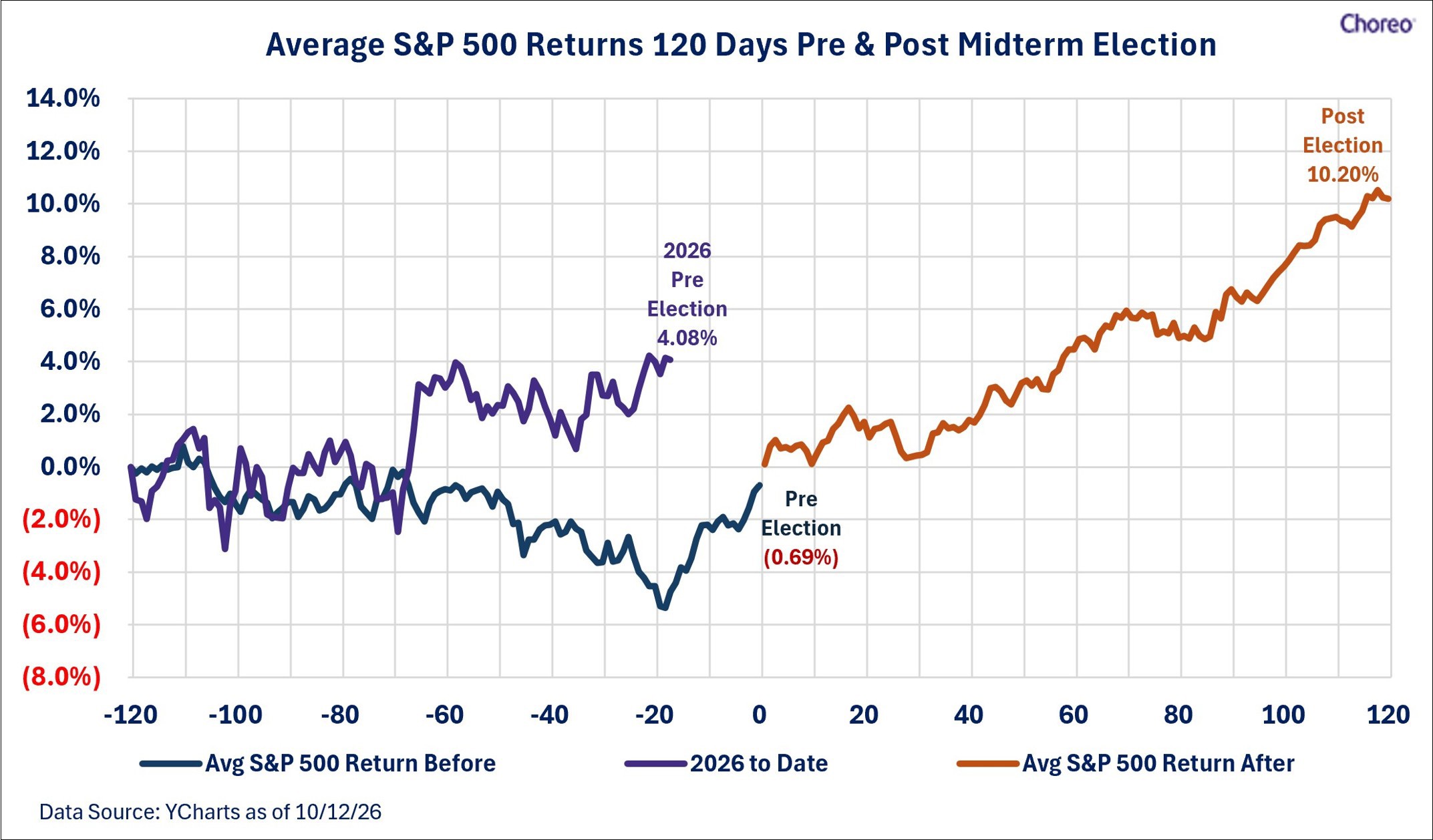
It is worth noting that 2026 has not followed the usual script. Stocks have shown strength despite concerns about higher oil prices, tariffs, and potential rate hikes. The S&P 500 is up 14.4% year to date through October 20th. That reinforces a key point: averages are a guide, not a forecast, particularly with the relatively small sample size (i.e., there have only been nine midterm elections since 1990 excluding 2026). The same is true in bonds. Historical relationships are useful, but the reason yields are moving matters as much as the direction of the move.
Divided Government and the Price of Capital
Midterms usually provide fertile ground for the party outside of the White House, and this cycle appears to be following that pattern. As of mid-October, election betting odds, which aggregates odds from popular prediction-market sites, gave Democrats a 91% chance of winning the House and a 66% chance of winning the Senate. In other words, the House appeared to lean toward a change in control, while the Senate remained more competitive (acknowledging that polls have not been overly accurate in recent cycles).
The party controlling the White House historically tends to lose congressional seats in midterms, increasing the likelihood of divided government. Markets have often been comfortable with gridlock because it can reduce the probability of sweeping policy changes and make the range of possible outcomes easier to assess. In reality though, average market returns have been solid after midterm elections no matter what the makeup of Congress looks like.
This year, the policy debate also intersects directly with bond markets. Government spending, taxes, regulation, and energy policy influence both the demand for capital and the supply of bonds. The election will not determine yields by itself, but it can shape the fiscal and investment backdrop that bondholders are being asked to finance.
Areas where the outcome could still shape sector-level returns include:
Fiscal and tax policy: Spending priorities, the deficit trajectory, and Treasury issuance can influence the supply of bonds and the level of longer-term interest rates.
Trade and tariffs: Much of trade policy runs through the executive branch, so a change in Congress may shift oversight more than direction. Tariffs can also affect inflation and corporate investment decisions.
Energy and infrastructure: Power demand from data centers and the broader AI buildout is increasing the importance of generation, transmission, permitting, and energy security.
Healthcare, financial regulation, and technology: Committee control can influence investigations, oversight, and regulatory tone, particularly for large-cap technology and AI.
Government financing: Budget choices and borrowing needs affect how much capital the public sector absorbs, potentially competing with private borrowers for investor funds.
What Matters More
Elections capture attention, but the forces worth watching most closely remain: inflation, the path of monetary policy, the durability and financing of AI-related capital spending, corporate earnings, and consumer health. These forces do not operate independently and are closely linked. Strong growth and investment can support profits while also keeping yields elevated. Higher yields can improve future bond returns while raising the hurdle rate for stocks, real estate, and capital-intensive projects.
That is why we would not interpret rising yields through a single lens. They reflect some combination of inflation risk, fiscal supply, central-bank expectations, growth, and competition for capital. The balance between those drivers will matter more to portfolios over time than which party holds the gavel.
Choreo’s Perspective
Trying to trade around election outcomes has rarely rewarded investors. Markets often price in expectations well before Election Day, and the post-election reaction can be the opposite of what many anticipate. The same caution applies to reacting to a sharp move in bond yields. Selling solely because prices have fallen can mean abandoning the asset class just as its income potential has improved.
The Choreo team remains focused on diversified, long-term portfolios aligned with each client’s goals, risk tolerance, liquidity needs, and time horizon. In fixed income, that means evaluating credit quality, maturity, and interest-rate sensitivity rather than treating “bonds” as a single trade.
Periods of election-driven or rate-driven volatility may also create opportunities for disciplined rebalancing, tax-loss harvesting, and reinvesting cash at more attractive yields. The objective is not to predict every vote, whether cast at the ballot box or in the bond market. It is to build a portfolio that can absorb changing verdicts. Enjoy the fall and leave the tricks to the trick-or-treaters. As always, please reach out to us with any questions or comments.
Important Disclosures
Opinions are as of the date referenced and are based on sources considered reasonable by Choreo. Opinions are subject to change based on market or economic conditions. There is no guarantee that any of these expectations will become actual results.
Choreo, LLC is an investment adviser registered with the U.S. Securities and Exchange Commission (SEC). Registration as an investment adviser does not imply a certain level of skill or training of the adviser or its representatives. This document contains general information, may be based on authorities that are subject to change, and is not a substitute for professional advice or services. This document does not constitute audit, tax, consulting, business, financial, investment, insurance, legal or other professional advice, and you should consult a qualified professional advisor before taking any action based on the information herein. Information has been obtained from a variety of sources believed to be reliable though not independently verified. Choreo, LLC, its affiliates and related entities are not responsible for any loss resulting from or relating to reliance on this document by any person. Internal Revenue Service rules require us to inform you that this communication may be deemed a solicitation to provide tax services. This communication is being sent to individuals who have subscribed to receive it or who we believe would have an interest in the topics discussed. Past performance does not indicate future performance. The sole purpose of this document is to inform, and it is not intended to be an offer or solicitation to purchase or sell any security, or investment or service. Investments mentioned in this document may not be suitable for investors. Before making any investment, each investor should carefully consider the risks associated with the investment and make a determination based on the investor’s own particular circumstances, that the investment is consistent with the investor’s investment objectives.
All registered trademarks are intellectual property of Choreo, LLC. © 2026 Choreo, LLC. All Rights Reserved.