“Show me the money!”
~ Rod Tidwell, Jerry Maguire
Combined capital expenditures at Alphabet (Google), Amazon, Meta, and Microsoft may soon total $1 trillion, and investors are beginning to question the return on this spending.
At the same time, consumer and enterprise adoption of AI has exploded, and it is driving significant revenue growth at the very companies doing the spending.
Democratic wins across the country have raised concerns that the data center buildout, a major driver of economic growth over the last few years, will slow dramatically under tighter oversight. The political landscape, as is often the case, is shifting and with it, uncertainty around policy will be debated in the months and years to come.
Introduction
Election night has come and gone, and the votes have all been counted (almost). The polls and prediction markets called the direction correctly but vastly underestimated the size of the swing. Democrats taking the House was expected and the Senate flipping was a possibility, but few saw the changes coming so far down the ballot in historically red areas.
There are still weeks to go before the new Congress is sworn in, but the markets are already trying to price in policy changes that could shape the economy. The President still holds veto power, so major changes at the Federal level are unlikely. Here is the catch: local laws, regulations and zoning boards decide what gets built and where, and many of the newly elected are far more critical of data centers. Gridlock at the Federal level may be the outcome, but at the state level, some real changes are possible.
The key takeaway for investors is that the data center buildout now faces two “show me the money” demands: investors want to see a return on investment, and communities want to see tangible benefits for having a data center in their back yard. For investors, some have been questioning whether the amount of capital expenditure going into AI infrastructure will pay off, or if the race to be the leader in AI will ultimately lead to overcapacity and a bust. In communities across many states, the pushback against data centers came from constituents on both sides of the aisle. If their new representatives enact policies that halt or delay data center construction, it could constrain what has been a major growth driver for the economy.
The Scale of the Buildout
Add up their own guidance and Amazon, Google, Meta, and Microsoft expect to spend over $700 billion on capital projects in 2026. That comes on top of a cumulative $600 billion spent in 2024 and 2025, most of it on chips, servers, data centers, and the power to run them.
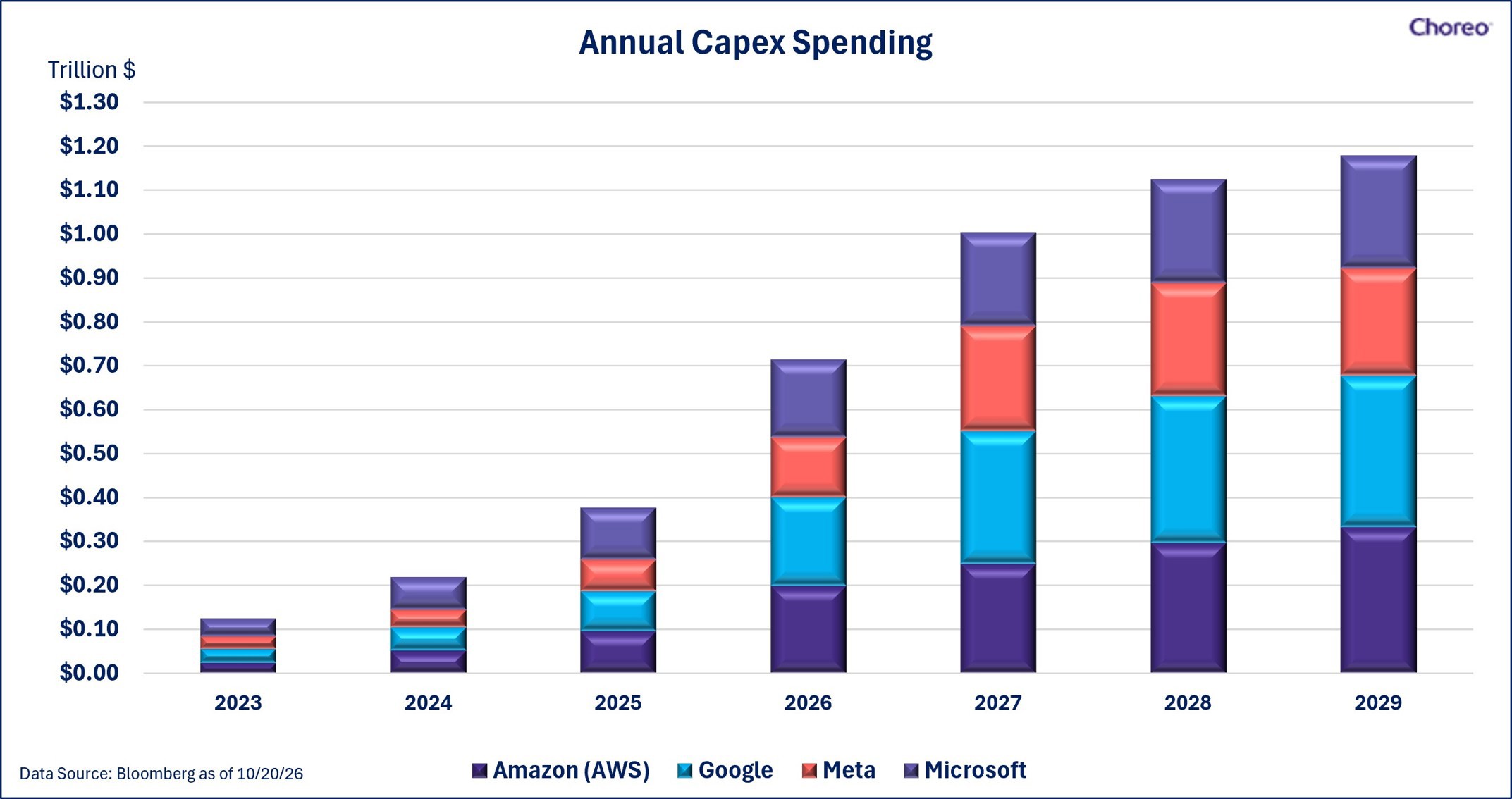
In third quarter earnings reports and conference calls, none of the four were signaling a slowdown. Alphabet expects spending to rise “significantly” in 2027, Amazon expects to spend “meaningfully more,” and Meta says it will keep investing aggressively. Microsoft trimmed its 2026 estimate to about $170 billion, but only because of third party capacity delays.
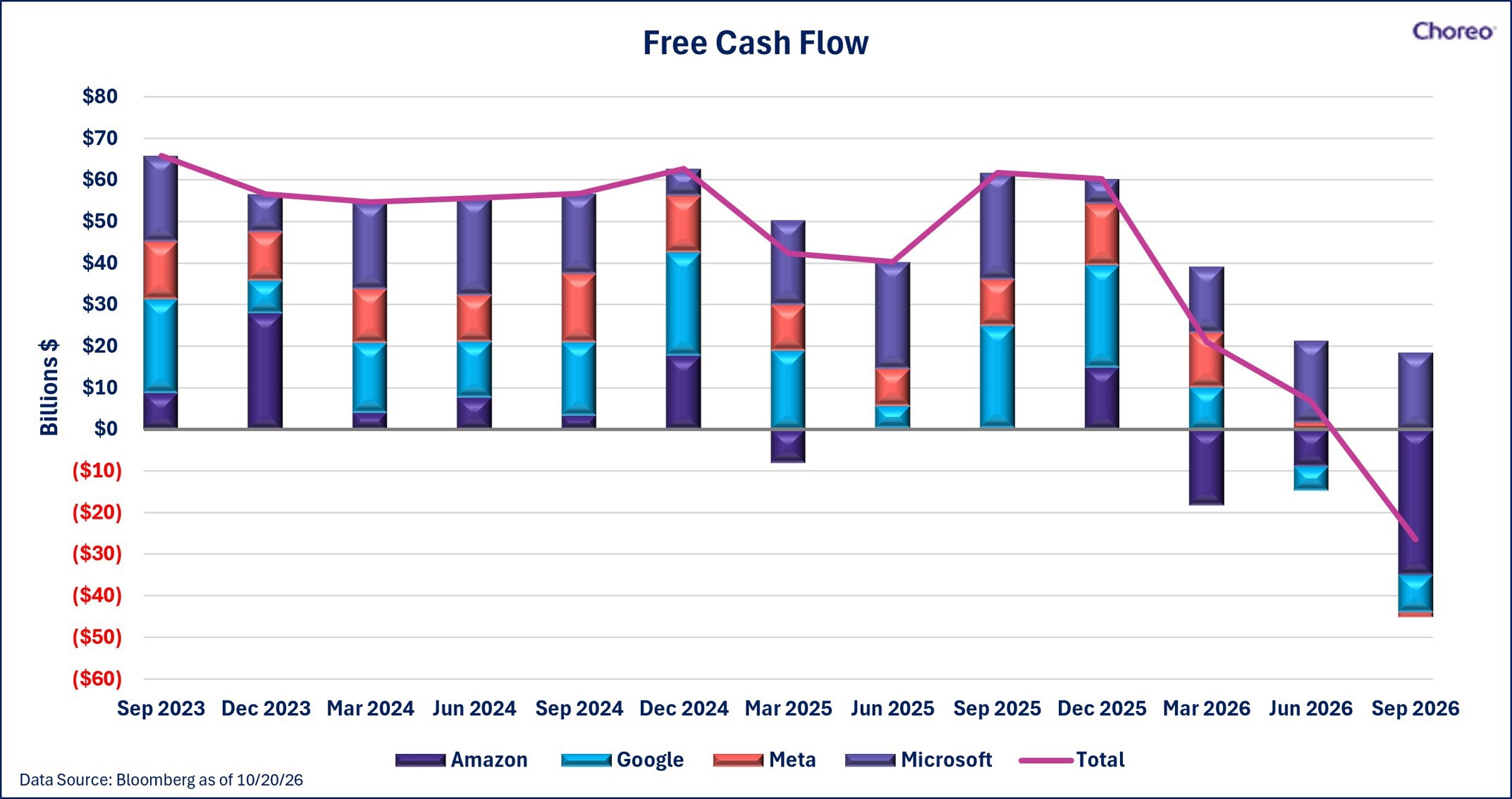
Not long ago, these companies had enviable, fortress-like balance sheets with little debt or even net cash (more cash than debt), and they were mostly free cash flow positive. This is slowly changing. Funding this much capex has meant drawing down cash, borrowing, and even selling shares (equity). Recent announcements and financial results show just how far each has gone:
Microsoft sold $25 billion of bonds in October, and its combined cash and short-term investments have declined by $37 billion over the last year.
Alphabet issued $28.7 billion of notes, sold shares through an at-the-market program and halted share buybacks.
Amazon more than doubled its long-term debt, from $65.6 billion to $173.1 billion, in the first nine months of this year.
Meta reported negative free cash flow in the third quarter after consistently posting over $10 billion per quarter in recent years.
Put side by side, the pattern is hard to miss: the cash that once funded the buildout is increasingly being supplemented by borrowed money and new shares. Combined free cash flow has declined from around $60 billion to negative $26 billion in the most recent quarter.
Spending on this scale is historic. If the projected AI capex occurs as planned, it could be a larger share of GDP than the telecom and fiber build of the late 1990s and early 2000s, the construction of highways in the mid-20th century, or the railroads of the late 1800s.1
The Demand is Real
Investors have been asking whether all this spending will ever deliver a return. For now, spending is running well ahead of revenue, but that revenue is showing up as is growth. The buildout is expensive, but the demand for AI is real. None of the hyperscalers are sitting on empty data centers waiting for customers to show up. On its third quarter earnings call, Microsoft’s finance chief officer said plainly that demand still exceeds supply.
Their own numbers back it up:
Cloud growth is accelerating. Microsoft’s Azure revenue grew 48%, Amazon Web Services grew 39%, and Google Cloud revenue more than doubled to $30.7 billion in the quarter.
Margins are widening. Google Cloud’s operating margin rose from 23.7% to 36.2% in a year, while AWS operating margin was up 4ppts from a year ago.
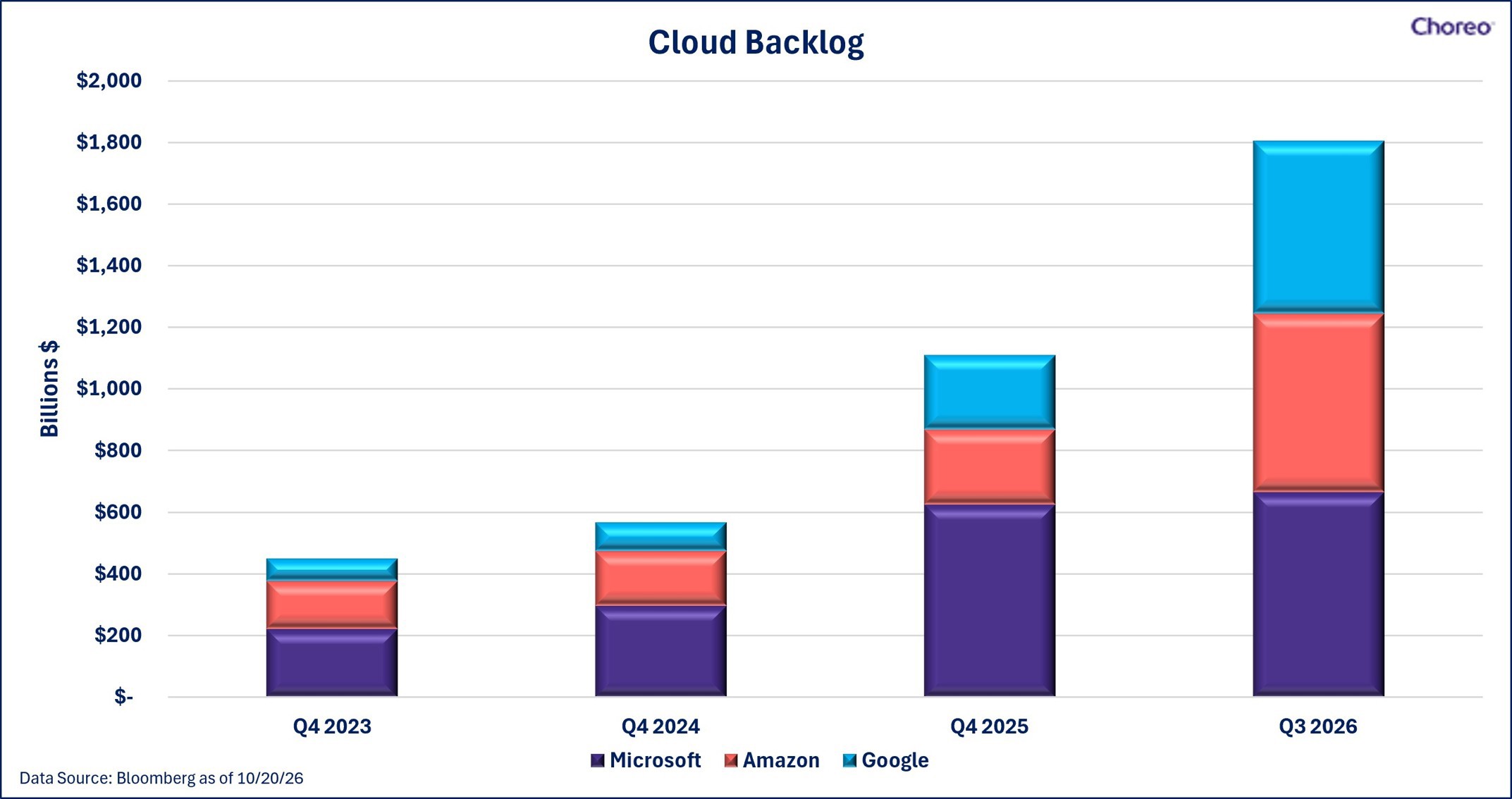
Contracted demand is enormous. Combined cloud backlog at Microsoft, Google, and Amazon is $1.8 trillion and growing. Backlog is revenue customers have already signed up for but not yet received.
Other metrics reinforce the point that AI is becoming part of our work and personal lives. Google’s Gemini app has more than one billion users and is the fastest growing product in the company’s history. Daily users of Microsoft’s Copilot are up 50% from last quarter and 5x from last year.
Tech After the Midterms
Equity markets, and technology names in particular, have been volatile since the election. The day after, the S&P 500 gained 1.6% and the Nasdaq Composite rose 1.4%. One day later, everything reversed, with the S&P 500 and Nasdaq Composite falling 4.4% and 5.5% respectively, each their worst day since April 2025.
The chart below shows how the S&P 500, the tech-heavy Nasdaq, and the AI centric PHLX Semiconductor Index have performed since election night.
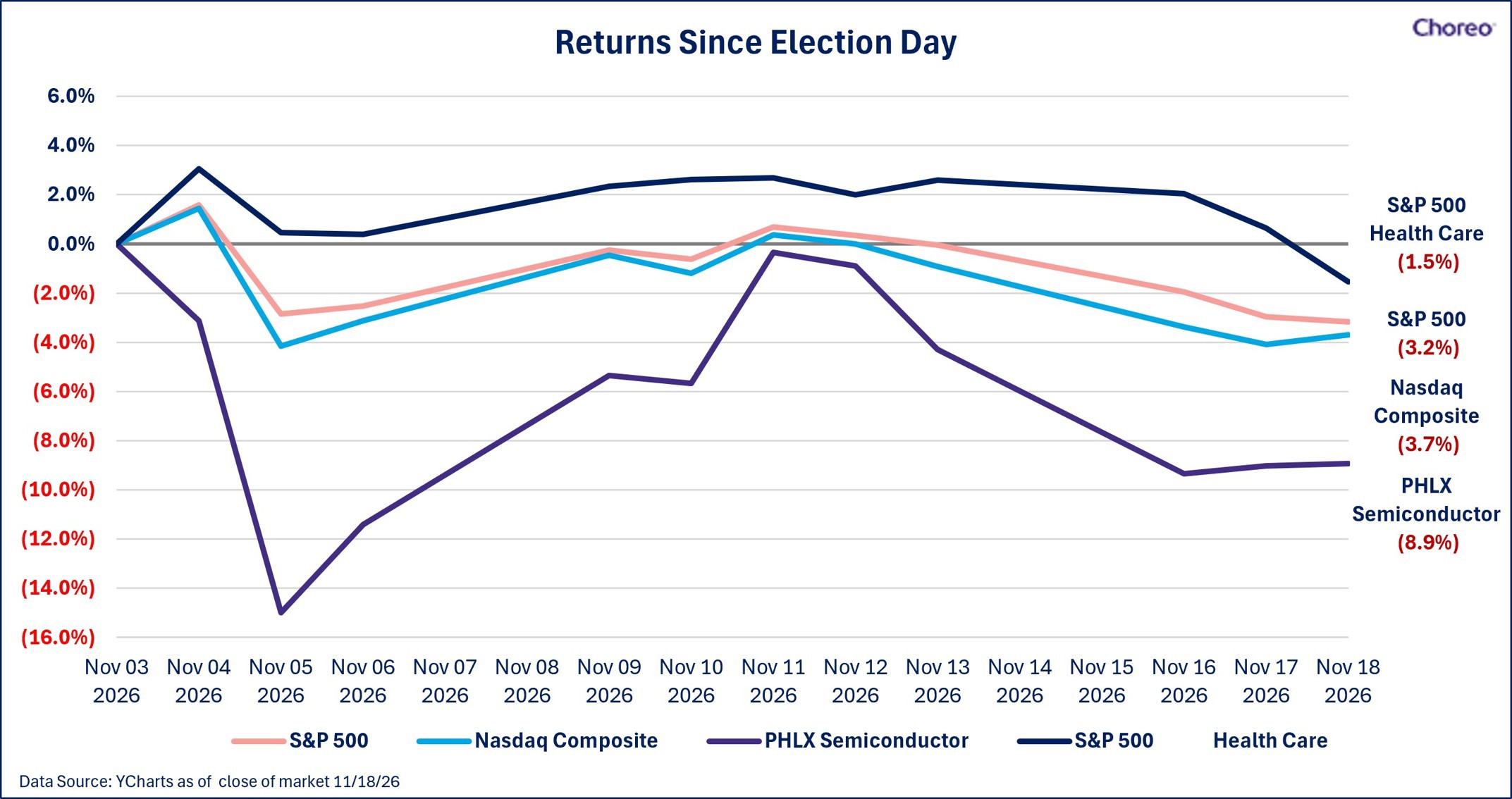
Investors are trying to figure out whether the Democratic gains in Texas, Ohio, and Georgia, three key states where local opposition to data centers has been growing, are good or bad for the AI trade, the economy, and the market. On one hand, a slower buildout would ease the cash demands on the biggest spenders, which would slow debt issuance and share sales and boost cash flow. On the other hand, a slowdown would hurt the suppliers of semiconductors, memory, hardware and power infrastructure, whose growth depends on continued construction. It could also slow job creation or even lead to layoffs across the tech and trades industries.
It is too early to know what will happen or how the market will react. It is unlikely that any data center already under construction will be stopped before it is finished, but the election could change how fast and where new ones are built. Future construction could move somewhere that welcomes it, whether that is another state or another country. AI is a global phenomenon and will likely continue, even if the U.S. puts up a more challenging regulatory front. Also, the campaign rhetoric may get bogged down in the practical realities of politics, like the influence of donors and the real-life economic cost of turning away jobs for your constituents.
What It Means for Portfolios
Even before the election, investors were separating companies with reliable profits from those that might be over-earning. That rotation is easy to miss if you only watch a headline index and the dramatic headlines that go with it, but it matters for how portfolios are positioned:
Ensure portfolios are diversified – Equity diversification across geography, market cap size, and style (growth/value) are important to limit the downside risk from being narrowly exposed to one area of the global economy.
Don’t follow one narrative – With a rapidly changing new technology, narratives can change quickly. Earlier this year, nearly all software stocks were down significantly (including Microsoft) because AI can easily write code. The narrative has since changed, and investors are now separating potential winners from losers, with the stocks of many of the perceived winners having recovered.
Traditional fixed income has a role – Investment grade fixed income still earns a place in portfolios as a growth hedge. If a slowdown in data center construction leads to slower growth and inflation, fixed income should be a relative ballast especially with starting yields much higher than where they were several years ago.
None of this requires a view on whether AI spending ultimately proves wise. Whether the buildout delivers on its promise or overshoots, diversification across sectors, company sizes and asset classes helps portfolios absorb either outcome.
Choreo’s Perspective
Big technology shifts tend to follow a familiar pattern. Investment runs ahead of revenue, skeptics question the payoff, and the eventual winners are not always the companies that got to market first or spent the most. The AI buildout may follow that path, or it may not.
At Choreo, we remain focused on diversified, long-term portfolios built around each client’s goals, risk tolerance, and time horizon. Periods of sector-driven volatility can create opportunities for disciplined rebalancing and tax-loss harvesting. Chasing the current narrative, or abandoning a well thought out plan because of a few weeks of headlines, rarely works out.
As we gather with family and friends this Thanksgiving, we are grateful for our clients, partners, and communities. We wish you a happy and healthy holiday season. As always, please reach out to your Choreo advisor with any questions or comments.
1 Konrad Putzier and Justin Lahart, "The AI Build-Out Is Becoming the Biggest Economic Bet in U.S. History," Wall Street Journal, September 23, 2026, https://www.wsj.com/economy/the-ai-build-out-is-becoming-the-biggest-economic-bet-in-u-s-history-c60716dd.
Important Disclosures
Opinions are as of the date referenced and are based on sources considered reasonable by Choreo. Opinions are subject to change based on market or economic conditions. There is no guarantee that any of these expectations will become actual results.
Choreo, LLC is an investment adviser registered with the U.S. Securities and Exchange Commission (SEC). Registration as an investment adviser does not imply a certain level of skill or training of the adviser or its representatives. This document contains general information, may be based on authorities that are subject to change, and is not a substitute for professional advice or services. This document does not constitute audit, tax, consulting, business, financial, investment, insurance, legal or other professional advice, and you should consult a qualified professional advisor before taking any action based on the information herein. Information has been obtained from a variety of sources believed to be reliable though not independently verified. Choreo, LLC, its affiliates and related entities are not responsible for any loss resulting from or relating to reliance on this document by any person. Internal Revenue Service rules require us to inform you that this communication may be deemed a solicitation to provide tax services. This communication is being sent to individuals who have subscribed to receive it or who we believe would have an interest in the topics discussed. Past performance does not indicate future performance. The sole purpose of this document is to inform, and it is not intended to be an offer or solicitation to purchase or sell any security, or investment or service. Investments mentioned in this document may not be suitable for investors. Before making any investment, each investor should carefully consider the risks associated with the investment and make a determination based on the investor’s own particular circumstances, that the investment is consistent with the investor’s investment objectives.
All registered trademarks are intellectual property of Choreo, LLC. © 2026 Choreo, LLC. All Rights Reserved.